Research / Adhesive bonding
Adhesive bonding
Adhesion from surface to structure: how adhesives wet, cure and age, how surface chemistry and geometry control a bond, and how joints perform and fail.
Adhesive bonding is where my research began, through the experimental fracture mechanics of bonded joints. But a bond is much more than a crack path. Its performance is set long before failure: by how the adhesive wets the surface, how it cures, and how the interface ages.
We work across these stages: surface preparation and nanoscale chemical modification, for example polymer brushes for rubber–metal bonding; curing and property development; durability of bonded structures; and joining of dissimilar materials. Increasingly, we modify the geometry of the surface itself, using patterns to influence both how a liquid adhesive wets and spreads, and how the cured joint later fractures.
Topics
- Wetting and spreading on structured surfaces
- Geometric surface modification and patterning
- Surface treatment and nanoscale chemical modification
- Curing, crosslinking and property development
- Durability and environmental ageing
- Joining dissimilar materials (metal–composite, rubber–metal)
- Fracture mechanics and test methods for joints
- Design for disassembly
Crossroads
With mechanical metamaterials →
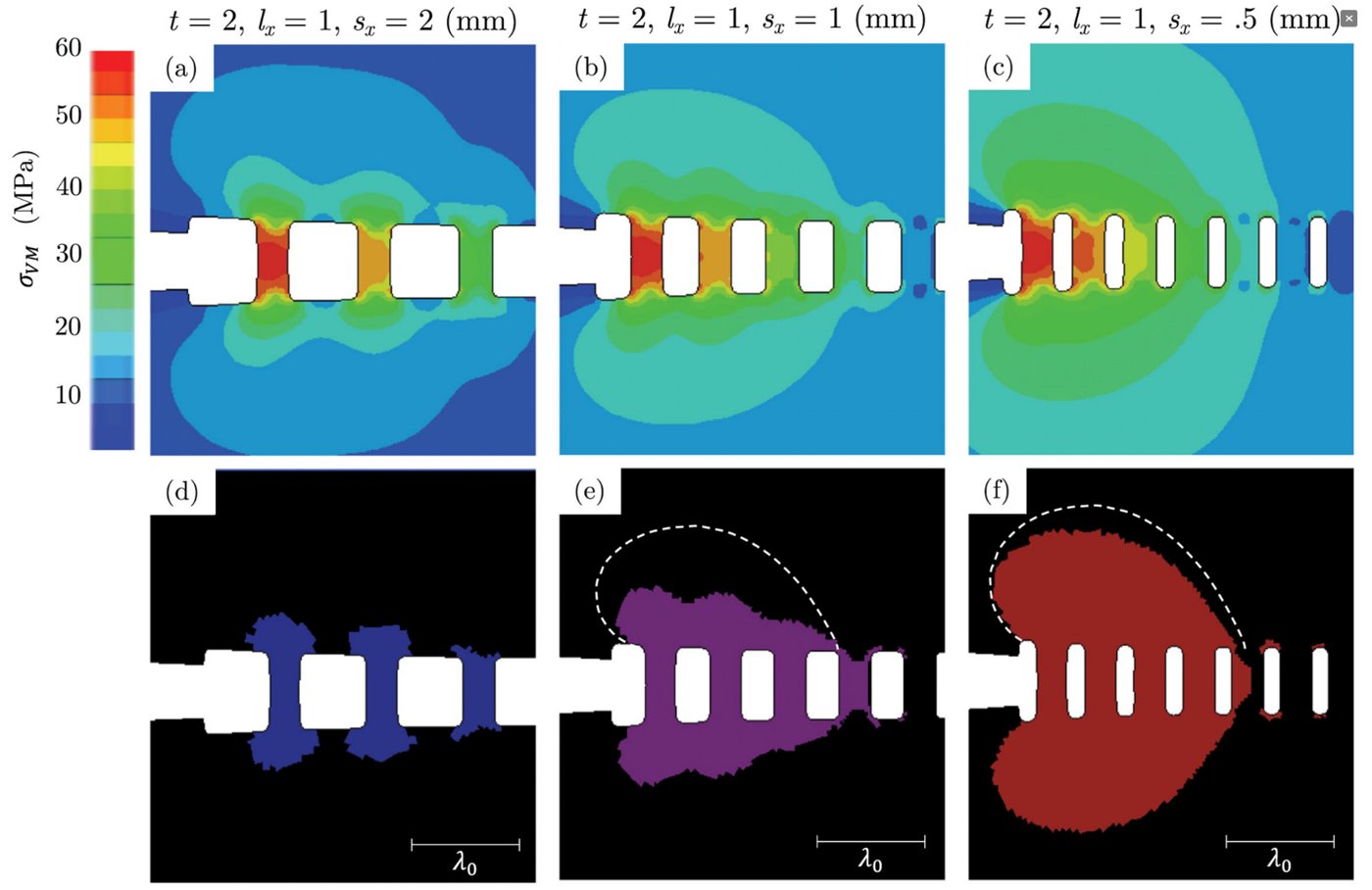
Geometric surface patterning sits exactly at the crossroads of bonding and metamaterials. Patterns on the bonded surfaces, or architected bondlines (metadhesives), influence how an adhesive wets the surface during bonding and how the joint fractures in service. They can separate fracture energy from crack area and make adhesion asymmetric: strong in service, separable at end of life.
- 2025P. Hu, S. Li, M.K. BudzikDecoupling fracture energy from crack area via surface patterning, Surf. Interfaces 62, 106066 (2025).
- 2021A.E.F. Athanasiadis, M.A. Dias, M.K. BudzikCan confined mechanical metamaterials replace adhesives?, Ext. Mech. Lett. 48, 101411 (2021).
- 2020S. Heide-Jørgensen, M.K. Budzik, K.T. TurnerMechanics and fracture of structured pillar interfaces, J. Mech. Phys. Solids 137, 103825 (2020).
With fibre & laminated composites →
Bonding composites to each other and to metals raises its own questions: the role of the adherend, thick multi-material bondlines, and co-cured joints in which bonding and composite processing happen in one step.
- 2025Ch. Van Innis, M.K. Budzik, T. PardoenBridging in co-cured composite joints, Int. J. Solids Struct. 309, 113194 (2025).
- 2024Ch. Van Innis, M.K. Budzik, T. PardoenUltra tough, architected material joints for integrated composite processing and bonding, Comp. Part A 177, 107949 (2024).
- 2021R. Lopes Fernandes, M.K. Budzik, S. Teixeira de Freitas, R. BenedictusMulti-material adhesive joints with thick bond-lines: crack onset and crack deflection, Comp. Struct., 113687 (2021).
- 2020R. Lopes Fernandes, S. Teixeira de Freitas, M.K. Budzik, J.A. Poulis, R. BenedictusRole of adherend material on the fracture of bi-material composite bonded joints, Comp. Struct., 112643 (2020).
A new platform for fatigue testing and fatigue-driven materials design, funded by the Carlsberg Foundation, supports work across composites, bonded joints and architected materials.
Related projects
- DuMats: Durable & sustainable metal–polymer hybrids via architected surfacesInnovation Fund Denmark · Grundfos
- Platform for fatigue testing and fatigue-driven materials designCarlsberg Foundation
Key papers
- 2021M.K. Budzik, M. Wolfahrt, P. Reis, M. Kozłowski, J. Sena Cruz, L. Papadakis, M. Saleh, K.V. Machalicka, S. Teixeira de Freitas, A. VassilopoulosTesting mechanical performance of adhesively bonded composite joints in engineering applications: An overview, J. Adhes. (2021).
- 2019R. Lopes Fernandes, S. Teixeira De Freitas, M.K. Budzik, J.A. Poulis, R. BenedictusFrom thin to extra-thick adhesive layer thicknesses: fracture of bonded joints under mode I loading conditions, Eng. Fract. Mech. 218, 106607 (2019).
- 2018S. Heide-Jørgensen, K. Birk Buhl, R. Krag Møller, M.K. Budzik, M. Hinge, K. Daasbjerg, et al.Ultra-thin Nano-scaled Chemical Modification to Cohesive Strength between EPDM Rubber and Metal, Int. J. Adhes. Adhes. 87, 31–41 (2018).
- 2018K. Birk Buhl, A. Kolding, R. Krag Møller, M. Kongsfelt, S. Heide-Jørgensen, M.K. Budzik, M. Hinge, S. Pedersen, K. DaasbjergHighly efficient rubber-to-stainless steel bonding by nanometer-thin cross-linked polymer brushes, ACS Omega 3(12), 17511–17519 (2018).
- 2014M.K. Budzik, J. Jumel, M.E.R. ShanahanExperimental investigation of a crack front triple line, Appl. Phys. B 114(2), 495–501 (2014).
- 2012M.K. Budzik, B. Mascaro, M. Castaigns, J. Jumel, M.E.R. ShanahanMonitoring of Crosslinking of a DGEBA-PAMAM Adhesive using Mechanical and Ultra-Sound Techniques, Int. J. Adhes. Adhes. 35, 120–128 (2012).
- 2012M.K. Budzik, J. Jumel, M.E.R. ShanahanAntagonist adhesion effects due to variable surface treatment, Soft Matter, DOI: 10.1039/c2sm25180a (2012). DOI
- 2009M.K. Budzik, J. Jumel, K. Imielińska, M.E.R. ShanahanAccurate and Continuous Adhesive Fracture Energy Determination using an Instrumented Wedge Test, Int. J. Adhes. Adhes. 29, 694–701 (2009).
Related
Fibre & laminated composites
Fibre-reinforced and laminated materials: how they fail, how long they last, and how to design and manufacture them across scales.
Explore →Mechanical metamaterials
Materials whose behaviour comes from architecture rather than composition: lattices, cut and folded sheets, foams, and natural architected materials such as bone.
Explore →Architected interfaces
Putting architecture into the interface itself: geometry that guides cracks, separates strength from toughness, and lets bonded structures be taken apart.
Explore →